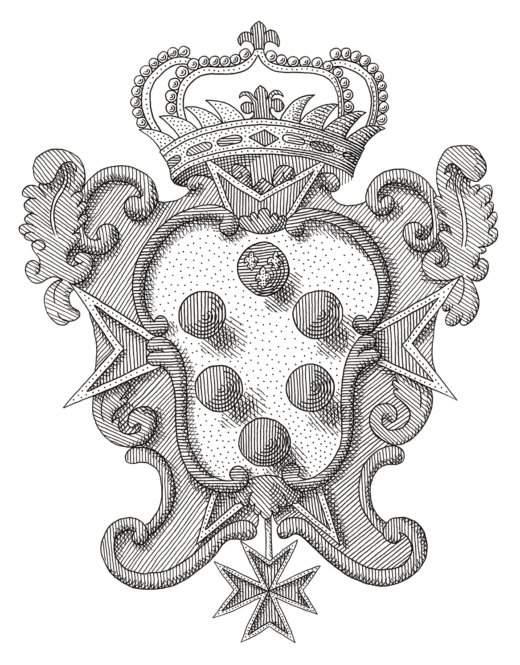
by Francisco Acedo Fernández
(King of Arms to the Titular Grand Duke of Tuscany)
1. Introduction
The history of the Grand Duchy of Tuscany did not end with the death of Gian Gastone de’ Medici in 1737, last sovereign of the line of Cosimo I. Despite the imposition of the House of Lorraine by decision of France and Austria, with the consent of the European powers, the succession question never lost relevance, since the papal bull of Pius V of 1569—still valid in canon law—and the imperial diplomas of 1532, 1537 and 1576 that founded the Tuscan State clearly established succession by the male line among the direct and collateral descendants (agnates) of the House of Medici.
Within this framework, the Neapolitan Medicean branch of the Princes of Ottajano, descended from Bernardetto de’ Medici, brother of Pope Leo XI and husband of Giulia de’ Medici, natural daughter of the first Duke of Florence, Alessandro, already recognized by contemporary genealogies, continued to represent the legitimate trunk of the dynasty. Today, its heir, H.R.H. Ottaviano de’ Medici di Toscana di Ottajano, embodies the historical and juridical continuity of the House, uniting in his person the grand-ducal rights and the Grand Mastership of the Holy, Illustrious and Military Order of Saint Stephen Pope and Martyr.
This article aims to clarify the historical and legal reasons why Ottaviano de’ Medici di Toscana di Ottajano is the current and legitimate Grand Duke of Tuscany and Grand Master of the Order of Saint Stephen P.M., by analysing the succession after Gian Gastone, last grand duke of his branch; the position of Giuseppe de’ Medici di Toscana di Ottajano; the imposition first Spanish (1718) and then Lorrainer (1735); the “debellatio” of the Habsburg-Lorraine (1870); the rights of the Ottajano branch and the exclusion of the branch of Marino de’ Medici di Ottajano (1849).
2. The Succession after Gian Gastone (1737)
The death of Gian Gastone de’ Medici, which occurred on 9 July 1737, marked the end of the grand-ducal branch of the family, direct descendant of Cosimo I, holder of the Duchy of Florence since 1537 and of the Tuscan throne since 1569. The disappearance of this branch did not, however, mean the extinction of the House of Medici, much less the annulment of its dynastic rights. The legitimacy of succession to the Duchy of Florence, to the Grand Duchy of Tuscany and to the Grand Mastership of the Order of Saint Stephen P.M. was, in fact, solidly guaranteed by a normative corpus that provided for the transmission of sovereignty to the direct descendants of Alessandro de’ Medici, first Duke of Florence, and, in the event of extinction of his male primogenitary line, to the closest male kinsmen of the Medici family “ad infinitum”.
In particular, agnatic succession to the Grand Duchy and to the Grand Mastership of the Order of Saint Stephen was ensured by the following official acts of investiture:
ORDER OF SAINT STEPHEN
Brief “Dilecto Filio” (1 October 1561) and Bull “His quae” (1 February 1562) of Pope Pius IV, which establish that the Grand Mastership of the Order be attributed to the Dukes of Florence existing pro tempore, later Grand Dukes of Tuscany. The Order is therefore institutionally linked to the sovereign title and is not the private property of a family.
SOVEREIGN TITLES
– Imperial diploma of Charles V of 1531.
Ducal title granted to Alessandro de’ Medici which allowed the family to regain dominion over Florence, lost in 1527 with their expulsion—the second—from the city. The document, preserved in the State Archives of Florence, bears the autograph signature of the Emperor and the seal enclosed in a gold case. “Declaramus (Dux n.r.) Alexander de Medicis… eius filij heredes et successores ex suo corpore discendentes masculi ordine prima genitura semper servato et illis deficientibus qui proximior masculos ex ipsa mediceorum familia erit, et sic successionem usque in infinitum iur primo genitura servato, sic atque esse debeat dicta Reipublica Florentina gubernii status atque, regiminis caput et sub eius precipua cura et proteptioni ipsa Civivitas et Republica.”
– Title of Grand Duke and Prince of Tuscany granted to the Medici in 1569 by Pope Pius V and its transmissibility.
The Bull conferring the grand-ducal title was signed by Pope Pius V on 27 August 1569 without the knowledge of Emperor Maximilian II, of the King of Spain and even of the College of Cardinals itself (ASF—International Treaties VII). In it there is frequent and clear reference to the previous Diploma granted by Charles V to the Medici, as well as to the many virtues and political merits of Cosimo, and it is asserted with authority that Duke Cosimo (“…Cosmus Ducem”) and all his successors who from time to time would be Dukes of Florence (“Eiusque successores pro tempore exisistentes Duces perpetuis futuris temporibus”…), are now elevated (“…Extollimus et amplificamus”…) to Grand Dukes and Princes of Tuscany (“…in Magnos Duces t Principes provinciae Ethruriae”…).
In the bull of Pius V, therefore, the ducal title already given to the Medici by Charles V was elevated—this title being referred to several times in the text of the decree—and the order of succession established by Charles V was likewise confirmed.
With regard to the order of succession, the papal bull of Pius V specifies that all those shall have the right to the grand-ducal titles who would have had the right to become Dukes of Florence (“Eiusque successores pro tempore existentes Duces perpetuis futuris temporibus”), that is, all those who could have succeeded to the grand-ducal title according to the order of succession established in the ducal investiture diploma granted by Charles V to the Medici.
Also in the bull of Pius V, then, similarly to what was provided by Charles V for the event of extinction of Alessandro’s dynastic line, the titles belong to the “proximior masculo ex ipsa medicea familia”, in the event of extinction of the line of Cosimo, precisely as occurred when Cosimo succeeded Alessandro. By writing “Eiusque successores pro tempore existentes Duces”, the Pope made explicit reference to the order of succession established by Charles V, which included direct descendants and agnates.
– Title of Grand Duke of Tuscany granted to the Medici in 1576 by Emperor Maximilian II and the dispute between Church and Empire.
When Emperor Maximilian II in turn conferred, on 26 January 1576, the grand-ducal title upon Francesco I de’ Medici, son of Cosimo (ASF, International Treaties VIII), he confirmed, as Pope Pius V had already done, the order of succession established by Charles V.
It is written, in fact, in the imperial diploma of investiture: “…Franciscum Medicem et eius discendentes in infinitum masculos legitimos et naturales, ac illis deficientibus, vel non exstantibus, proximiores masculos ex medicea familia in perpetuum, ut supra omnes tanta successores ordine ac iure primigenij in Magnos Duces Hetruriae eorum locorum, que ibidem ipse dux Franciscus…”.
This second grand-ducal title was necessary to appease the anger of the Emperor and of the King of Spain, who had judged the grand-ducal title given by Pope Pius V to Cosimo as an offence to the imperial authority itself, the only one which, according to them, would have had the necessary authority to confer dynastic titles upon the Medici, such as those assigned by Pius V.
Indeed, the Emperor considered free Tuscany as an imperial fief, and therefore held that only the authority of the Emperor, and not that of the Pope, could confer upon the Medici a title as authoritative as the grand-ducal one.
It was therefore established, in agreement with the Pontiff, that the imperial diploma should make no mention of the grand-ducal title that had previously been given to Cosimo I, lest it appear that Francesco, by accepting the imperial grant, renounced that which had been given him by Pope Pius V.
The historian Domenico Moreni reports in “Incoronazione del Duca Cosimo Medici in Gran Duca di Toscana” (Florence, Stamperia Magheri, 1819, p. 60) that it was in fact agreed between the Medici and the Pope to sign an accord, which then remained private, in which Francesco expressed that he accepted the imperial grant only to “emancipate himself from the annoyances caused him by the Emperor, and not in order to desist from availing himself of the favours bestowed upon him by the Holy See, of which his father Cosimo, and he himself, had never ceased to make use, and the same would be done by his successors.”
3. The Tuscan Dynastic Crisis and the Origin of the Succession Rights of the House of Medici of Ottajano
The question of succession to the throne of the Grand Duchy of Tuscany in the first decades of the eighteenth century represents one of the most significant moments in European dynastic history, not only for the political implications that ensued, but above all because it marked the clash between ancient imperial feudal law and the new theories of modern natural law. It is precisely in this context that the historical and legal roots of the dynastic rights of H.R.H. the Grand Duke Ottaviano de’ Medici di Toscana are found, first-born direct descendant of the legitimate first-born male branch of the House of Medici of Ottajano.
Upon the death of Prince Ferdinando de’ Medici in 1713, the direct grand-ducal line seemed destined for extinction. By virtue of the imperial diplomas of Charles V (1530) and Maximilian II (1569), as well as the papal bull of Pius V, which still sanctions the investiture of Tuscany in favour of the Medici family, the Grand Duchy—as an immediate fief of the Empire—should have passed to the closest male agnate. This right belonged, according to the imperial regulations then in force, to Prince Giuseppe de’ Medici of Ottajano, ancestor of the present Grand Duke Ottaviano.
At first, Grand Duke Cosimo III himself did not call this practice into question, even going so far as to declare, through his Secretary of State Gondi, to the French ambassador Gercy—who would record it in his diplomatic diary—that he intended to name Giuseppe de’ Medici as possible successor to the Grand Duchy and to communicate it to the Ministers of the European states then gathered at The Hague, in order to find a means that could more easily appease the foreign powers at war since 1702 over the Spanish succession.
However, in 1711 the jurist Nicolò Francesco Antinori, having heard the Grand Duke’s intention to appoint Giuseppe de’ Medici of Ottajano as possible successor, proposed a radical change of perspective with his celebrated “Discorso sopra la successione di Toscana”, in which he rejected feudal law in favour of reason of state and the new natural-law doctrines. His objective was to exclude the agnates and steer the succession towards a foreign house—such as that of Lorraine—deemed better suited to guarantee the stability of the Grand Duchy.
This discourse immediately found the full support of the Tuscan Senate and of the powerful Secretary of State Carlo Antonio Gondi, giving rise to a veritable institutional coup d’état: political and legal power imposed itself upon the sovereign and prevented him from upholding the legitimate dynastic rights of the Ottajano branch. Cosimo III, under strong pressure, then named his daughter Anna Maria Luisa, Electress Palatine, as possible successor to the throne and, already in February 1711, declared by will that the Electress could succeed to the entire Medicean patrimony, thus in fact violating the fideicommissum established by Leo X in favour of male primogeniture ad infinitum, respected by all previous grand dukes.
This choice had profound effects: it effectively excluded Giuseppe de’ Medici of Ottajano from patrimonial and political succession, while opening the way to the hereditary claims of Spain, which asserted the rights of Queen Elisabeth Farnese, granddaughter of Margherita de’ Medici and therefore closest heir by blood of the Electress Palatine. It was a most serious act in the eyes of the Empire: both the testament and the appointment of the daughter were considered a foris factura, that is, a violation of feudal law, which the Emperor could not accept without calling into question his own sovereign authority.
4. The Tuscan Dynastic Crisis Acquires a European Dimension
The controversial decision of Cosimo III de’ Medici to name his daughter, Electress Palatine Anna Maria Luisa, as possible successor to the Grand Duchy of Tuscany—in violation of feudal law and of dynastic fideicommissa—not only produced internal legal effects, but also had wide-ranging diplomatic consequences, determining an escalation that would forever alter the political configuration of Tuscany and of all Europe.
At a time when tensions between the Empire and Spain had not yet subsided after the War of the Spanish Succession, the choice of Cosimo III offered Elisabeth Farnese, Queen of Spain and great-granddaughter of Margherita de’ Medici, the legitimacy to claim the patrimonial goods of the Medicean dynasty and, with them, the entire Grand Duchy. The fall of the fideicommissa in favour of Prince Giuseppe de’ Medici of Ottajano—the legitimate agnatic heir according to imperial and papal Bulls—thus opened the way to Spanish ambitions over Tuscany.
The stakes were extremely high: the Medicean allodial goods constituted the essential financial basis of the Tuscan State. Without them, no government—neither legitimate nor usurping—could have maintained economic and institutional stability. Upholding the strategic need to secure for Tuscany a reliable guidance, Spain began to assert succession rights over the Grand Duchy, presenting itself as a new tutelary power over the territory.
The crisis finally erupted with Spain’s armed intervention in Italy (1717), a prelude to the War of the Quadruple Alliance. The stated aim was twofold: to recover the dominions lost at Utrecht (Naples, Sicily, Sardinia) and to obtain the Tuscan succession for the young Charles of Bourbon, son of Philip V and Elisabeth Farnese. The Peace of The Hague (1720) did not break this design; rather, it confirmed that, upon the deaths of the Medici and the Farnese, Charles would inherit both Parma and Tuscany, thus placing an international seal upon the Bourbon claims.
Meanwhile, Emperor Charles VI—aware of the illegitimacy of Cosimo III’s foris factura according to imperial law—also officially recognized Giuseppe de’ Medici of Ottajano as “Prince of Tuscany”. This recognition, contained in a diploma of 1720 preserved in Vienna and in the private Medici Archives of Ottajano, conferred upon Giuseppe official charges (such as the delivery of the Kingdom of Sardinia to the House of Savoy) and consolidated his status as legitimate heir of the grand-ducal dynasty. Such a title, indeed, derived directly from the imperial Bulls of 1530 and 1576 and from the papal bull of Pope Pius V of 1569, which established that, in the absence of direct descendants, Tuscany belonged to the collateral agnates, that is, to the Ottajano branch.
From that moment on, Giuseppe de’ Medici exercised, by imperial and canonical right, the dignity of titular Grand Duke of Tuscany, a title which he transmitted to his descendants by agnatic line down to the present, in the person of H.R.H. Ottaviano de’ Medici di Toscana.
In an attempt to counter the legitimate Medicean right and justify the choice of the Electress Palatine, Tuscan diplomacy opened a sterile and artificial legal debate on the supposed “freedom of the Florentine State”, entrusted to Ambassador Neri Corsini. This argument, aimed at denying imperial authority over the Grand Duchy, was received coldly by the European chanceries and provoked a heated “pamphlet war” between imperial and Tuscan jurists. The outcome was disastrous: Tuscany was isolated and, in 1723, the formal protest of the Grand Duke was ignored by the Congress of Cambrai.
The coup de grâce to the Medicean succession finally came with the War of the Polish Succession, during which, in 1736, Charles VI formally assigned Tuscany to the House of Lorraine by means of an imperial decree of grant that formally revoked that previously given by Maximilian II to Francesco I de’ Medici, thus in practice betraying feudal law and the still-valid papal investiture. However, until the death of Grand Duke Gian Gastone (1737), Giuseppe de’ Medici remained the legitimate dynastic heir to the grand-ducal throne, and this legitimacy was never revoked nor challenged by the Church or the Empire.
5. The Debellatio of the Lorrainers after 1870
The installation of the House of Lorraine on the Tuscan throne in 1738, the result of a diplomatic agreement of 1735 between France and Austria and not of dynastic right, entailed from the outset a fragility in the legitimacy of this dynasty. For over a century the Lorrainer grand dukes governed Tuscany as a territory closely bound to Vienna and, in many respects, dependent on imperial policy.
The definitive crisis came with the Second War of Italian Independence. In 1859, after the Battle of Magenta, Piedmontese troops occupied Tuscany and forced Leopold II of Lorraine and his son Ferdinand IV to abandon Florence. On 16 August 1859 the Tuscan National Assembly proclaimed the end of the Lorrainer dynasty and the provisional annexation to the Kingdom of Sardinia. This produced a first act of political rupture: the Lorrainers lost effective control of the territory.
In the following years the situation was consolidated. On 20 December 1866, the Tuscan Lorrainer branch was formally absorbed into the Imperial House of Austria: Ferdinand IV was allowed to retain the grand-ducal title as an honorific, but his children became simply archdukes and archduchesses of Austria, without the style of princes of Tuscany. The supposed Tuscan dynasty was dissolved within the parent House.
The decisive blow was the abdication of Ferdinand IV in 1870, by which he renounced all rights over Tuscany in favour of Emperor Franz Joseph I of Austria. This act, fully recognized within the Imperial House, extinguished any capacity of the Lorrainer branch to claim its own rights over Tuscany or over the Grand Mastership of the Order of Saint Stephen.
The death of Ferdinand IV in 1908 closed the chapter irreversibly. In the same year, Franz Joseph I issued a decree prohibiting the descendants of Ferdinand IV from using the titles of Grand Duke, Prince or Princess of Tuscany, and forbidding the grant or use of honours and decorations connected to the extinct Tuscan State. In this manner, the Lorrainer dynasty of Tuscany was declared legally extinct.
German historiography, with authors such as Bernd Braun and Karl Vocelka, has underlined that this process constitutes a true dynastic debellatio: not only the loss of the State (1859), but the legal and dynastic disappearance of the Tuscan Lorrainer branch (1870–1908). The Almanach de Gotha, considered an international authority in dynastic matters, reflected this clearly: in the 1907 edition it still recognized Ferdinand IV as Grand Duke of Tuscany; in that of 1909, published after his death, the descendants appear solely as archdukes of Austria, without any reference to Tuscany.
To this process a more recent fact is added: the renunciation of Archduke Otto of Habsburg-Lorraine in 1961, made effective in 1967, in order to return to Austria. With it any political claim of the Imperial House over Tuscany was extinguished, confirming that the Tuscan Lorrainer branch was not only politically divested, but also legally annulled as a dynastic line.
Consequently, the debellatio of the Lorrainers left a vacuum of legitimacy. With the formal disappearance of the Austro-Tuscan line, the only branch with intact dynastic rights over the Grand Duchy and over the Grand Mastership was that of the Medici of Ottajano, direct heirs of Bernardetto and depositories of the agnatic succession established ad infinitum by papal bulls and imperial diplomas.
6. The Protest of Giuseppe de’ Medici di Toscana, Prince of Ottajano (1688–1743)
A central aspect culpably ignored by European diplomacy down to our days was the papal bull of Pius V of 1569, which still confers spiritual and legal authority upon the Medicean investiture and, with solemn wording, establishes the anathema against anyone who should violate its terms. No abrogation was ever issued, and the transgression of the papal act would have entailed, according to the canon law in force in the eighteenth century, latae sententiae excommunication for those who promoted an illegitimate succession.
However, no excommunication was ever issued against Giuseppe de’ Medici or against his descendants, nor even against those who appropriated power in Tuscany after 1737. This official silence of the Holy See takes on a fundamental legal and moral value: it represents a tacit confirmation of the validity of the dynastic title of the House of Medici of Ottajano.
In this context, the title of Grand Duke of Tuscany, today legitimately claimed by H.R.H. Ottaviano de’ Medici, is therefore not the fruit of a personal pretension, but the legally grounded and canonically legitimate heritage of an unbroken dynastic line, protected by the papal bull and never condemned by the Church.
Moreover, to reaffirm imperial right and the legitimacy of the Medicean succession, Emperor Charles VI in 1720 officially recognized Giuseppe de’ Medici of Ottajano as “of Tuscany”, including him in a solemn diploma and entrusting him with high-level military and diplomatic charges, such as the delivery of the Kingdom of Sardinia to the House of Savoy. This formal act amounted to a legal recognition of his dynastic legitimacy as heir of the Grand Duchy of Tuscany, and of the patrimonial goods that accompanied it.
Finally, by virtue of the Medicean fideicommissa renewed over time and kept in the archives of the Ottajano family, Giuseppe was considered by common law the legitimate heir of the allodial goods of the House of Medici of Tuscany. The maintenance of such goods—which guaranteed the functioning of the state apparatus—would have been essential to exercise an effective government, and therefore Prince Giuseppe lodged a formal protest against the sale of the allodial goods of the House of Medici, which had been ceded the previous year by the Electress Palatine to the Grand Duke of Tuscany then in office, through a family pact between the Electress Palatine and Grand Duke Francis Stephen of Lorraine, signed in Vienna on 31 October 1737, on condition, however, that no particularly precious goods should be taken away from Florence and from Tuscany.
On the morning of 11 November 1738 Prince Giuseppe, who had been in Florence for several months, presented himself to Abbot Tornaquinci, Councillor and Secretary of State to Grand Duke Francis Stephen of Lorraine, begging him to submit to the Regency Council a written memorandum which, on 18 November, was likewise delivered to the Grand Duke by Gaetano Antinori, Councillor of State and of Regency and Secretary of War, descendant of that Senator Nicolò Antinori who in 1711 had been the author of the coup d’état in Florence against the Medicean dynasty. As attested by the documentation present in the State Archives of Florence (MM f.633 ins.4), Abbot Tornaquinci immediately went to the President of the Regency Council, Richecourt, and both immediately agreed to make a copy of the protest to be sent to the Grand Duke, and that Abbot Tornaquinci should return to Prince Giuseppe de’ Medici his protest, replying to him curtly in such a form that it could never be inferred that a protest was being spoken of! This behaviour was likewise approved by the other members of the Regency Council, in the openly expressed fear that Prince Giuseppe de’ Medici di Toscana di Ottajano might in some way make the protest public. On that same 18 November orders were then requested from the Grand Duke by Richecourt as to what should be done if the protest were made public, and the Grand Duke replied by a letter of 10 December ordering Richecourt that, in case the protest became public, it should be judged by the supreme court “groundless and ridiculous”, “without, however, entering into any discussion with the aforesaid Prince Don Giuseppe de’ Medici”.
Meanwhile, the protest had become public, for many copies were printed and circulated in Florence under the title “Protest presented by the Prince of Ottajano to the Regency Council in Florence”.
On 30 December 1738 the Supreme Magistrate, responding to the precise orders of the Grand Duke, dared to post upon the door of the Palazzo Vecchio a public proclamation declaring that the protest “—that the paper was never presented to the Regency Council—”, “that there was reason to believe that said paper was not the work of the aforesaid Sir Don Giuseppe de’ Medici”, that “as regards the testament of Pope Clement VII there can be no goods subject to his fideicommissum”, “that the supposed testament of Francesco I is a chimera invented with more artifice than truth of fact”, etc. The Supreme Magistrate therefore, without having conducted any kind of legal confrontation, on the morning of its first meeting for this case ruled directly that “the paper entitled—Protest presented by the Prince of Ottajano to the Regency Council—in Florence, which he currently exhibits, is null and of no effect or value, seditious, rash, and contrary to the respect due to the Majesty of the Sovereign; and furthermore it is ordered that it be torn up in public form, and that by the Magistracy of the Eight proceedings be instituted against the Author, and against whoever has published and distributed it, to the end of punishing them with the rigour of the laws.”
It is obvious, then, that the testaments of Clement VII and of Francesco I, now unfindable in the State Archives of Florence, would have demonstrated the basis of Giuseppe’s protest, in which he affirmed that “in those testamentary dispositions of the Pontiff and of the Grand Duke, and of the other Most Serene predecessors of Grand Duke Gian Gastone lately deceased, there is clearly expressed and continued a firm and deliberate will of those testators that all their allodial effects, villas, estates, palaces, and other goods should remain subject to a rigorous fideicommissum, it being their intention and indubitable will that all the aforesaid goods be maintained and preserved in perpetuity within their agnation.”
Fortunately in the private Medici archives of Ottajano in Naples there are found the following documents capable of proving Giuseppe’s good reasons:
20)“Memorandum in petition for the succession to the inheritance of Giulio de’ Medici, later Pope Clement VII, and of Don Francesco de’ Medici, Grand Duke of Tuscany, in favour of the Prince of Ottajano, and draft of said memorandum”, 21 November 1738, fols. 23, printed.
21)“Memorandum in petition in favour of the Prince of Ottajano to be put in possession of all the goods of Clement VII and of Grand Duke Francesco to preserve the splendour of the family”, as above, fols. 4.
22)“Allegation in petition, that the Prince of Ottajano be put in possession of the goods of the fideicommissa instituted by Clement VII and by Grand Duke Don Francesco de’ Medici by their testaments of 30 July 1534 and 28 April 1582”, as above, fols.
12.) “Various writings relating to the dispute for the recovery of the fund of the 300 places of Monte of the city of Florence left by Doña Anna Maria Ludovica de’ Medici, Electress of the Rhine, by her testament of 5 April 1739, to the male agnate of the Medici family, and by the Grand Duke of Tuscany ordered to be given to Sir Nicola de’ Medici, and licence granted by His Majesty to Sir Don Giuseppe de’ Medici to be able to appeal to the aforesaid Grand Duke to reclaim said fund; family tree of the Medici”, 1744–1793, fols. 16.
7. The Rights of the Ottajano Branch and the Branch of the Medici Tornaquinci
From this historical, legal and documentary heritage there derive today the dynastic rights claimed by H.R.H. the Grand Duke Ottaviano de’ Medici di Toscana: not only as continuator of an agnatic line recognized by the Empire, but also as custodian of a tradition that sinks its roots into imperial laws, papal fideicommissa and the diplomatic history of modern Europe.
The soundness of the rights of the House of Medici after the death of Gian Gastone is therefore not a retrospective construction, but finds testimony in the diplomatic documentation of its time, and from the conjunction of bulls and diplomas of investiture there issued an unequivocal principle: agnatic succession ad infinitum. As long as there existed legitimate male descendants, direct or collateral agnates of the House of Medici, the Grand Duchy of Tuscany and the Grand Mastership of the Order of Saint Stephen could not be considered extinct, and upon the death of Gian Gastone in 1737 the dynastic rights did not disappear, but passed to the Ottajano branch, settled in Naples since the sixteenth century through the agency of Bernardetto de’ Medici.
The branch of the Medici di Toscana di Ottajano and that of the Medici Tornaquinci are the only ones still existing of the great Medicean family of Tuscany; however, the branch of the Medici di Toscana di Ottajano, being the closest by agnation to the grand-ducal branch descended from Cosimo I, is the only one legitimized to bear today the title of Grand Duke of Tuscany, with the qualities of Guarantor of the Family Pact of the Electress Palatine of 1737, as well as legatee of the dynastic primogeniture established by testament by the same Electress.
On the aforesaid points the numerous genealogical and historical sources preserved in the State Archives of Florence, the State Archives of Naples, the Diplomatic Archives of the French Ministry of Foreign Affairs, the private Archives of the Medici di Toscana di Ottajano, the Central State Archives—Consulta Araldica section—and finally the Civil Registry of the Italian Republic are very clear.
8. The Question of the Three Lines of the Ottajano Branch
The lineage of Ottajano had its origin in Bernardetto de’ Medici, son of Ottaviano de’ Medici—cousin of Cosimo I—and of Francesca Salviati, granddaughter of Lorenzo the Magnificent. He was also husband of Giulia de’ Medici, daughter of Duke Alessandro. From the acquisition of the fief of Ottaviano in 1567, the family was integrated into the high Neapolitan nobility, where it achieved notable prestige. The fief of Ottaviano was elevated to a principality by Philip III of Spain in 1609, and Charles II granted the duchy of Sarno in 1695 and the Grandeza de España in 1700. They were enrolled in the patriciate of Naples in the Seggio of Capuana, in the Pio Monte della Misericordia and in the Deputation of the Royal Chapel of the Treasure of Saint Januarius. Knights of the Golden Fleece and of Saint Januarius, among many other orders and corporations. By marriage, especially through the union of the eighth Prince Michele de’ Medici with Marianna Gaetani dell’Aquila, the Medici of Ottajano incorporated the predicate of Venafro and the title of Duke of Miranda, thus consolidating their position in the Kingdom of Naples and later in that of the Two Sicilies.
The Ottajano branch also produced leading figures in the ecclesiastical and political sphere: a pope, Leo XI; a cardinal, Francesco de’ Medici of Ottajano; diplomats and ministers such as Luigi de’ Medici of Ottajano, representative of the Kingdom of Naples at the Congress of Vienna; or Michele de’ Medici of Ottajano, senator of the Kingdom of Italy.
In the nineteenth century, the descent of H.R.H. Giuseppe de’ Medici di Toscana, titular Grand Duke of Tuscany, sixth Prince of Ottajano, divided into three branches:
– The line of Michele of Giuseppe (1771–1832), seventh prince, married to Isabella Albertini, became extinct in the male line in 1894 with the death of H.R.H. Giuseppe de’ Medici di Toscana di Ottajano.
– The line descending from Marino, son of Giuseppe (1774–1825), who married Raffaella Prisco on 14 June 1799, from whom Luigi (1815–1865), who married Marianna Perris on 9 August 1849, from whom Costantino (1845–1885) and Alberto (1854–1925) and their descendants, was excluded from the Neapolitan Nobility and from the Grand Ducal dynastic titles of Tuscany as a consequence of the aforementioned marriage of Luigi to Marianna Perris, contracted in violation of the provisions governing the Nobility of the Kingdom of the Two Sicilies, as established by Article 12 of the Royal Dispatch of 20 December 1800 (*). For this reason, following the establishment of the Kingdom of Italy in 1861, the descendants of Luigi, son of Marino, were neither entered in the regional registers of nobility nor included in the 1933 Golden Book of the Italian Nobility. Likewise, they are not, and have never been, registered in the civil registry of the Italian Republic under the surname de’ Medici followed by the noble territorial designation “di Toscana di Ottajano.”
*(Memorial of the Heraldic Council (Consulta Araldica), Vol. I, p. 68, Rome, Tipografia Cotta, 1873.)
– The line of Alessandro of Giuseppe (1777–1843), married to Francesca d’Aquino, gave origin to the present grand-ducal branch, which is the only one to have maintained intact the dynastic rights and which today represents the continuity of the House in the person of H.R.H. the Grand Duke Ottaviano de’ Medici di Toscana di Ottajano.
After the death without issue of H.R.H. Giuseppe de’ Medici di Toscana di Ottajano, which occurred in 1894, the Consulta Araldica of the Kingdom renewed to the Medici only the noble titles of Spanish origin, by means of certain ministerial decrees which in fact and in law created new noble titles of Savoyard law, therefore different from the analogous titles of Spanish law which became extinct in 1894 with Giuseppe, last prince of the Primogenitary Neapolitan branch. For the new Savoyard titles only the following three family branches were provided, as recorded in the Libro d’Oro of the Italian Nobility:
MEDICI (DE) (primogenitary line of Ottaiano) Duke of Miranda, Prince of Ottaiano, Duke of Sarno (Napolitan law), Predicates of Venafro, Filignano and Valle (mf), rr.ll.pp. ass. 20.9.1912. d.m. 6.11.1912 to Maria daughter of Michele.
MEDICI (DE) (secondogenitary line of Ottajano) Noble of the Princes of Ottaiano (mf), enrolled in the Libro d’Oro of Naples; Marquis of Acquaviva, Marquis of Fornelli, Predicate of Colli (Napolitan law), rr.ll.pp. ass. 4.6.1899 succ. Carmignani. d.m. 6.6.1899 to Francesca, Alessandro, Andrea, Maria, Giuseppe, Teresa, Alfonso, Beatrice, Giuliano children of Goffredo.
MEDICI (DE) Noble of the Princes of Ottaiano (mf), enrolled in the Libro d’Oro of Naples. d.m. 2.10.1902 to Giuliano son of Alessandro.
The line of Marino was therefore excluded from the Nobility of the Kingdom of Italy because it had previously already been excluded in fact from the Neapolitan Nobility before the institution of the new Kingdom (1861). Following the historical and legal precedents of Tuscan historical tradition it was also excluded in fact from the Tuscan dynastic titles, nor would it be possible today to re-include it, likewise by virtue of the dynastic family laws established by testament by the Electress Palatine, which provide for the obligation of residence in Florence for the Head of the Grand-Ducal House.
9. Grand Duke Ottaviano de’ Medici di Toscana di Ottajano
The succession of Ottaviano de’ Medici di Toscana di Ottajano as titular Grand Duke is founded upon the soundness of the dynastic rights of being the first-born male of the first-born line with best right of the Neapolitan branch of the Medici di Toscana di Ottajano, heir of the primogeniture of the House of Medici after the extinction of the branch of Cosimo I in 1737.
The papal bulls of Pius IV and Pius V fixed transmission by agnatic line ad infinitum to the male descendants of the House. The Ottajano line, strengthened by its bonds with the grand-ducal trunk through the marriages of Bernardetto with Giulia de’ Medici and of Ottaviano with Francesca Salviati, granddaughter of Lorenzo the Magnificent, preserved that continuity without interruptions or renunciations. In contrast, the Lorrainer line, legally extinguished by the abdications of 1870 and 1961, today lacks any basis to claim the succession.
Grand Duke Ottaviano has oriented his mission towards an eminently cultural, historical and humanistic sphere, in keeping with the heritage of the Medicean Renaissance. Under his impulse academic initiatives, editorial projects and activities of patrimonial dissemination have been developed which reaffirm the role of the House of Medici as a reference for patronage, civic spirit and humanistic renewal.
The rediscovery of the ideals of Lorenzo the Magnificent and of Cosimo I finds today expression in a New Medicean Humanism, which promotes dialogue between tradition and modernity, respect for human dignity, the protection of nature and the promotion of art and culture as instruments of social cohesion.
As for the Grand Mastership of the Holy, Illustrious and Military Order of Saint Stephen Pope and Martyr, Ottaviano de’ Medici has received it as the legitimate inheritance of his forebears, adapting it to the needs of the twenty-first century.
The current statutes orient the mission of knights and dames to the service of God and neighbour, to the practice of justice, to helping the weak and to the defence of biodiversity and the environment. The Medicean Environmental Corps of the Order of Saint Stephen (CAMOSS) has been created, which channels the work of members into missions of ecological protection, research and training, in collaboration with the Accademia Umanistica Medicea.
In this way the Order of Saint Stephen has found a new function in the contemporary world: to be at once a testimony of historical and dynastic continuity and a vehicle of universal ethical values, projecting into the present the spiritual and cultural heritage of the House of Medici.
10. Conclusions
The history of the Grand Duchy of Tuscany and of the Holy Military Order of Saint Stephen is articulated around a fundamental principle: the dynastic continuity of the House of Medici, guaranteed from its foundation by papal bulls and imperial diplomas that established transmission by agnatic line ad infinitum.
The extinction of the popolano branch in 1737 opened a crisis that the European powers resolved by imposing the House of Lorraine, alien to the Medicean trunk. However, as the documentation shows, that decision was political in nature and did not extinguish the legitimate rights of the Medici of Ottajano, collateral heirs strengthened by marriages with the grand-ducal lineage and never affected by renunciations or exclusions.
The debellatio of the Lorrainers between 1870 and 1908, confirmed by the abdication of Archduke Otto in 1961–1967 and by the suppression of the titles in the Almanach de Gotha, marked the legal and irrevocable end of the Austro-Tuscan branch. Since then, the only possible continuity falls upon the Medici di Toscana di Ottajano, recognized in noble tradition and historiography as the only surviving branch of the House.
Today, in the person of H.R.H. Ottaviano de’ Medici di Toscana di Ottajano, three dimensions are synthesized: the historical and legal legitimacy of his succession; the cultural and humanistic function, heir to Renaissance patronage; and the contemporary Grand Mastership of the Order of Saint Stephen, renewed with an ethical and environmental vocation.
The figure of Grand Duke Ottaviano thus represents not a recent appropriation, but the living expression of an uninterrupted continuity, which links the greatness of Medicean Florence to the challenges of the present world, in fidelity to the principles of justice, dignity and humanism that marked the history of the House of Medici. To deny the rights of the Head of the House of Medici to the Throne of the Grand Duchy of Tuscany is simply absurd and ridiculous, just as it would be to deny that the sun shines only during the day.